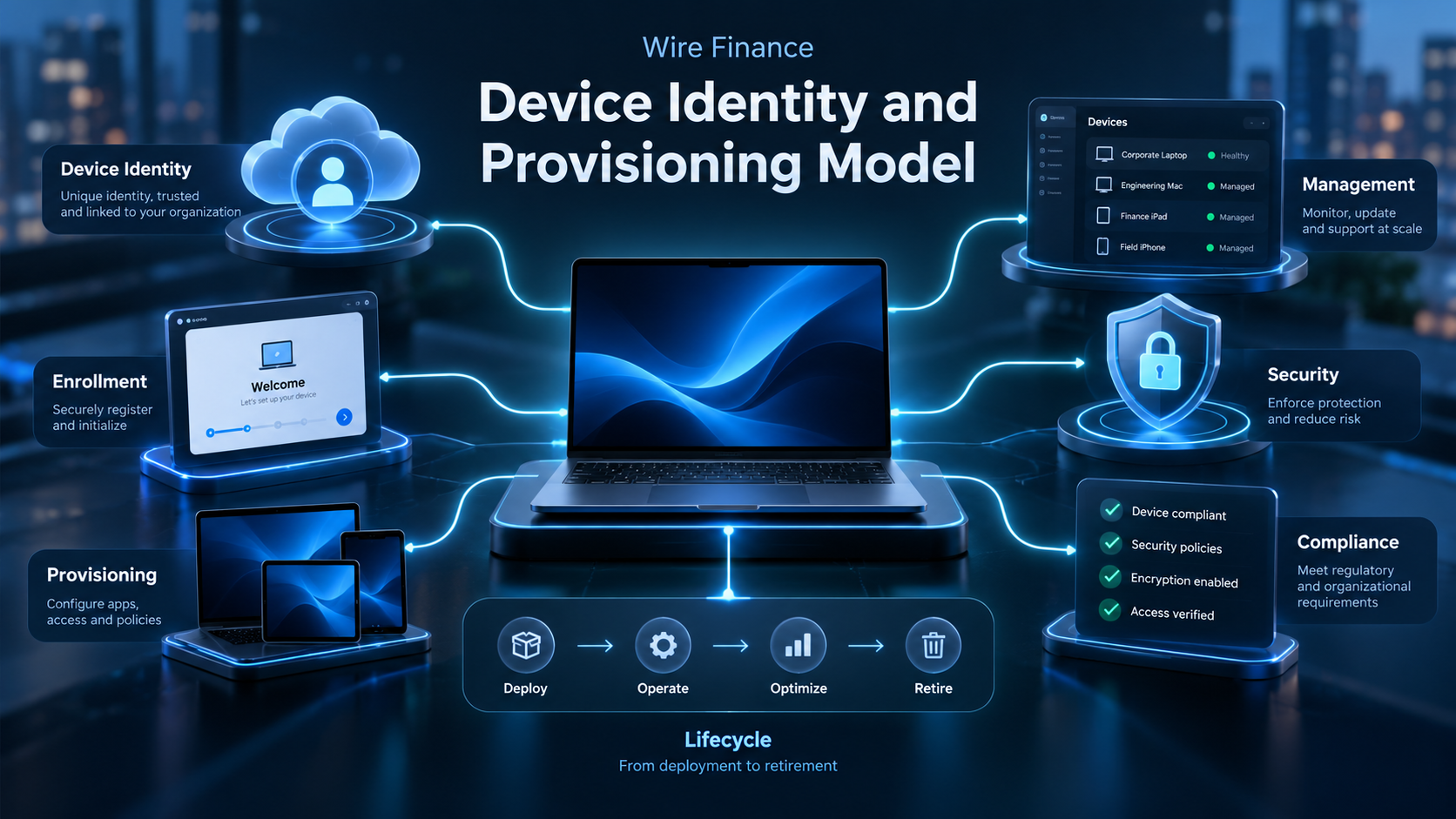
Wire Finance now has an identity model.
We know who our employees are, what access they should receive, how privileged access is separated, and how those permissions change throughout the employee lifecycle.
But users do not normally access company resources on their own.
They do so through devices.
That introduces a new set of questions.
What kind of device is being used?
Who owns it?
How should it be identified?
How does it become part of Wire Finance?
How should it be provisioned and managed?
What makes it trusted?
And what happens to it when it is reassigned, rebuilt, or retired?
Why Device Design Comes Next
Knowing that Olivia Carter is a Finance Analyst tells us a great deal about who is requesting access.
It does not tell us whether the device she is using should be trusted.
```text Olivia Carter │ ├── Managed Corporate Laptop ├── Privileged Workstation ├── Personal Device └── Unknown Device
Explore the Device Provisioning Model
Device Types and Ownership
Not every device serves the same purpose. Define the corporate, privileged, pilot, test, and specialist devices Wire Finance will need — and who is responsible for them.
Device Naming Convention
A device name should tell us something before we even open its record. Define a naming model that makes Wire Finance devices easier to identify, manage, and investigate.
Device Identity and Join Model
A device can be company-owned without being joined, managed, compliant, or trusted. Define how Wire Finance devices receive an identity and how Microsoft Entra Join, Intune, and Autopilot fit together.
Device Group Design
A single device may need several classifications at once. Wire Finance uses device groups to separate provisioning, operational management, privileged endpoints, staged rollouts, and controlled security testing.
Windows Autopilot Classification
Before a device is provisioned, Wire Finance needs to know what kind of build it should receive. Autopilot classification separates standard corporate endpoints from privileged workstations before deployment begins.
Standard Corporate Provisioning Journey
Follow a Wire Finance corporate Windows endpoint from asset registration to employee handover as Autopilot, Microsoft Entra ID, Intune, applications, security controls, and compliance turn hardware into a managed endpoint.
Privileged Workstation Provisioning
Privileged administration needs more than a separate admin account. Follow how Wire Finance provisions, hardens, validates, and governs a dedicated Privileged Access Workstation.
Pilot and Test Device Model
Pilot devices prove that a change works safely. Test devices deliberately exercise controlled failure paths. Wire Finance separates the two so new configurations can be validated without turning production endpoints into experiments.
Device Security and Compliance Model
A managed device is not automatically a trusted device. See how Intune security configuration, Defender risk signals, compliance evaluation, and Conditional Access combine to determine whether a Wire Finance endpoint should be allowed to access corporate resources.
Device Lifecycle Overview
Follow a Wire Finance device through its complete managed lifecycle, from acquisition and provisioning to reassignment, security response, retirement, and final disposal.