Up to this point, most of the Wire Finance device design has answered one question:
How do we get a device safely into service?
We have defined how devices are:
- owned
- named
- classified
- joined
- provisioned
- managed
- secured
- tested
- evaluated for compliance
But provisioning is only the beginning.
A corporate device may remain inside the organisation for years.
During that time it may be updated, repaired, reassigned, placed into a pilot, investigated after a security event, rebuilt, retired, or eventually disposed of.
The final part of the device model therefore asks:
What happens to a device from the moment Wire Finance acquires it until the physical asset permanently leaves the organisation?
The principle is simple:
a managed device has a lifecycle, not just an enrollment event.
The Complete Device Journey
The Wire Finance device lifecycle is shown below.
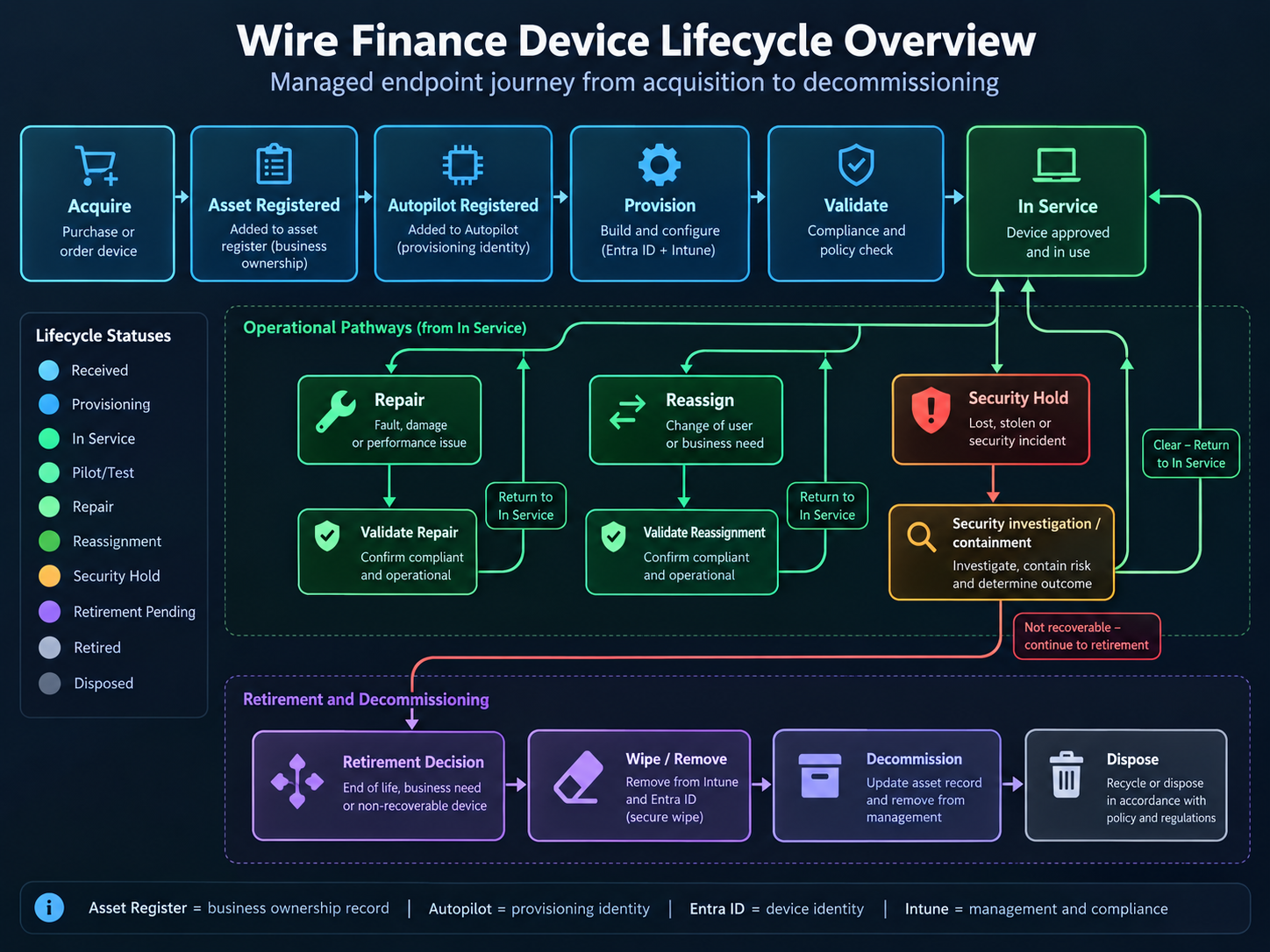
At a high level, the journey can be understood in three phases:
ENTER SERVICE
      ↓
Acquire
      ↓
Register
      ↓
Provision
      ↓
Validate


OPERATE
      ↓
In Service
      ↓
Maintain
      ↓
Repair / Reassign / Security Response
      ↓
Return to Service Where Appropriate


LEAVE SERVICE
      ↓
Retirement Decision
      ↓
Decommission
      ↓
Dispose
The journey is not always a straight line.
A device may move through paths such as:
In Service
    ↓
Repair
    ↓
In Service
or:
In Service
    ↓
Reassignment
    ↓
Provision / Validate
    ↓
In Service
A security event may take the device down a different path:
In Service
    ↓
Security Hold
    ↓
Investigate
   /           \
Recover       Retire
   ↓
Return to
Service
Lifecycle management therefore means controlling both the normal journey and the situations where a device leaves that normal path.
One Device, Several Records
Consider:
WF-LT-001
That one physical device may eventually be represented across several systems:
WF-LT-001
│
├── Wire Finance Asset Register
├── Windows Autopilot
├── Microsoft Entra ID
├── Microsoft Intune
└── Microsoft Defender for Endpoint
Those records are not duplicates.
Each answers a different question.
| Record | What It Tells Us |
|---|---|
| Asset Register | What physical asset does Wire Finance own, who has it, and what is its current business state? |
| Windows Autopilot | What provisioning relationship and intent has been assigned to the hardware? |
| Microsoft Entra ID | What is the device’s organisational identity? |
| Microsoft Intune | Is the device managed, configured, and compliant? |
| Microsoft Defender for Endpoint | What security activity and risk are associated with the endpoint? |
The lifecycle process keeps these different views aligned.
A device may be physically returned but still have cloud records.
It may be removed from service while still existing in the asset register.
It may be reassigned to another employee while remaining the same physical asset.
That is why no single Microsoft portal represents the entire device lifecycle.
Business State and Technical State Are Different
Wire Finance also separates the business state of the physical asset from its technical state inside Microsoft platforms.
For example:
Asset Register
      ↓
In Service
Repair
Reassignment
Security Hold
Retirement Pending
Disposed
while Microsoft platforms may independently tell us things such as:
Entra Joined
Intune Managed
Compliant
Non-Compliant
Defender Onboarded
At Risk
Those states are related, but they are not interchangeable.
A device marked Security Hold in the asset register may still be enrolled in Intune because Security needs to investigate it.
A device marked Retirement Pending may still have Entra, Intune, Defender, or Autopilot records that need to be cleaned up before the lifecycle is complete.
This is why the Asset Register remains part of the Wire Finance device model.
Lifecycle Responsibility Changes Too
Responsibility follows the device through its lifecycle.
At different points, the device may involve:
- IT for acquisition, provisioning, assignment, repair, and retirement
- Security for privileged-device decisions and incident response
- Microsoft Intune for management and compliance
- Microsoft Defender for Endpoint for security monitoring and risk
- the business for user assignment, handover, and retirement decisions
- the Asset Register for the authoritative physical-asset record
No single portal — and no single technical control — owns the entire device story.
The lifecycle works because those responsibilities remain coordinated.
From Provisioning to Lifecycle Management
Wire Finance can now describe the complete device journey:
Acquire
   ↓
Record
   ↓
Classify
   ↓
Provision
   ↓
Secure
   ↓
Validate
   ↓
Operate
   ↓
Maintain / Reassign / Investigate
   ↓
Retire
   ↓
Decommission
   ↓
Dispose
The important point is that provisioning creates the beginning of a managed device.
It does not create the end state.
The organisation must continue to know:
what the device is, who is responsible for it, whether it is safe to use, and what should happen to it next.
The sections that follow break this lifecycle into the individual decisions required to keep a Wire Finance device accountable from acquisition through final disposal.
Explore the Device Lifecycle
Acquisition and Asset Registration
Before a device reaches Autopilot, Wire Finance needs to establish ownership, business purpose, accountability, and an authoritative record for the physical asset.
Device Registration
The asset exists. Now the hardware needs to enter the provisioning system so Windows Autopilot can recognise it and place it on the correct deployment path.
Device Provisioning
Follow a registered Wire Finance device as Autopilot, Microsoft Entra ID, and Microsoft Intune transform it into an organisationally managed Windows endpoint.
Validation and Entry Into Service
Reaching the Windows desktop is not the finish line. Wire Finance validates identity, management, security, applications, compliance, and assignment before approving a device for operational use.
Device Operation
Most of a device's lifecycle is spent in service. See how Wire Finance keeps the business asset record aligned with Intune management, Defender security signals, and the device's approved purpose.
Maintenance and Repair
Updates, troubleshooting, repairs, and remediation are normal parts of endpoint life. The challenge is returning every device to its approved managed state before normal use resumes.
Reassignment and Internal Reuse
A useful device should not be discarded simply because its user changes. Wire Finance uses controlled reset, reprovisioning, reassignment, and validation to prepare corporate hardware for its next approved purpose.
Security Hold and Recovery
Lost, stolen, high-risk, and suspected compromised devices need a lifecycle state of their own. Security Hold stops normal use while Wire Finance decides whether trust can be restored.
Retirement Decision
Retirement starts with a business decision, not a Delete button. Wire Finance first decides the future of the physical asset, then selects the correct technical offboarding actions.
Decommissioning and Disposal
Retirement says the device should leave. Decommissioning makes it happen by reconciling Intune, Entra ID, Defender, Autopilot, group membership, business records, and the physical asset.